

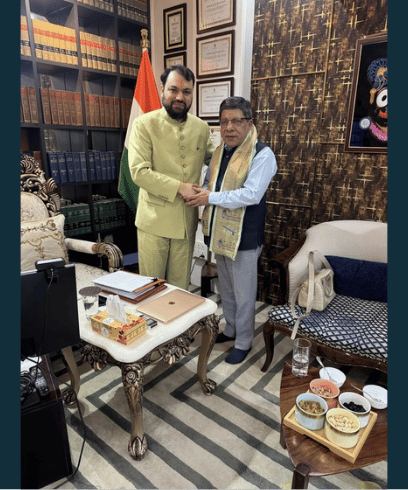
The interaction
An exchange of perspectives.
Dr. Karan Garg in an interaction with Dr. Rajiv Narang.
About the participant
Experience in context.
Dr. Narang’s scientific and institutional experience concerns fire, explosive and environment safety, including leadership of the Centre for Fire, Explosive and Environment Safety at DRDO.
Bharat Pulse Policy Lens
Safety governance must outlast a one-time certificate.
Independent Bharat Pulse analysis, not a quotation or a position attributed to the participant.
How can institutions turn technical evidence into a sustained safety-management process?
Policy in focus
DRDO’s public CFEES catalogue identifies documented safety regulations and manuals across different classes of activity, illustrating the role of formal standards and recorded procedures in safety governance.
Bharat Pulse assessment
The policy question is not how to handle a hazardous material; it is how an organisation knows that its safety responsibilities remain fulfilled as its operations change. A certificate, test report or written procedure should be connected to defined scope, competent review, change control and periodic reassessment.
Bharat Pulse’s view is that scientific evidence and management accountability need to reinforce one another. Procurement should specify the evidence required without treating a document as a universal assurance for every operating condition. Institutions also need a route for escalating uncertainty and recording corrective action. This is a governance-level perspective only: it provides no operational instructions for explosives or dangerous materials and does not imply approval of a product, facility or client.
What to watch
Policy sources & scope
Evidence of a documented safety-governance framework. This article does not reproduce technical handling, storage or operational instructions.
Editorial review: 2026-09-18. This is the policy-lens review date, not the meeting date. Source periods are shown above; older frameworks are not presented as new announcements.