


TLGS POLICY PERSPECTIVE · MOBILITY & DIGITAL ENTERPRISE
No-commission rides.
More for drivers. Fairer fares.
Why Rapido’s technology-only proposal deserves a fair GST distinction—and why the opportunity extends to India’s next generation of local startups.
TLGS Policy & Research Published 29 September 2026Updated 30 September 2026
TLGS represents Rapido in this GST Council matter. This is our policy perspective.
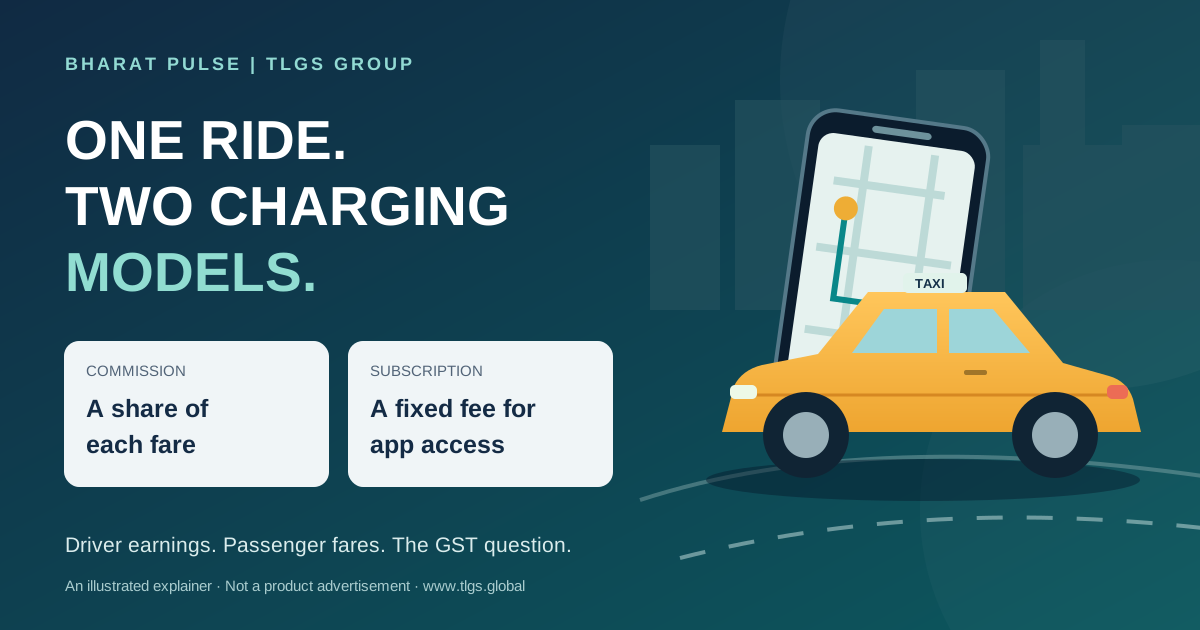
A driver should not have to surrender a large share of every fare simply to find a passenger. A passenger should be able to benefit when the cost of connecting with that driver falls. Rapido’s no-commission auto/cab approach puts that simple idea at the centre of the GST debate.
The proposed distinction is equally simple: the driver supplies the ride; a genuinely non-intermediating platform supplies technology access. The platform earns a separate app fee rather than a share of the fare. TLGS’s case is that the law should recognise that difference instead of treating every digital introduction as full transport intermediation.
WHY THIS PROPOSAL DESERVES SUPPORT
Keep more with the driver. Open the market to more choice.
More of the fare retained
Replacing a larger per-trip deduction with a smaller fixed app cost leaves more with the driver.
Room for lower fares
A lower cost of using the app lets the driver accept less from the passenger without losing the same amount in earnings.
Independent work
Direct payment and freedom to accept a ride reduce dependence on platform-controlled settlement and targets.
Local innovation
A clear technology-only category gives small businesses and driver cooperatives a more predictable way to enter.
What Rapido is proposing—and why drivers find it attractive
Rapido’s published auto/cab terms describe a subscription for access to its software, a fare agreed by the driver and passenger, and payment made directly to the driver. Its captain terms also permit drivers to work on other platforms. This is a materially different commercial starting point from deducting commission from each fare. Rapido’s published terms
The financial attraction does not require complicated theory. When the fixed app charge is below the commissions it replaces, the driver retains more from the same rides. Rapido co-founder Pavan Guntupalli has publicly described drivers choosing to join the platform after the move away from commission, reducing the need to spend on attracting them. Co-founder interview
A ₹400 RIDE · A SIMPLE ILLUSTRATION
A lower deduction can benefit both sides.
20–25% commission
₹400 fare − ₹80–₹100 platform deduction
₹300–₹320left with the driver after that deduction
Separate app subscription
₹400 fare − ₹10 allocated app cost
₹390left with the driver after that cost
The passenger saves ₹40; the driver retains ₹30–₹50 more than in the commission example.
Assumptions: ₹100 daily app pass spread across 10 rides; 20–25% commission used only for comparison. Figures are illustrative, not current tariffs of any named company, and exclude GST, fuel and other expenses. The allocated pass cost depends on rides completed.
Uber and Ola’s own moves show that per-trip commission is not inevitable
The traditional commission-led model associated with Uber and Ola puts a deduction between the passenger’s payment and the driver’s earnings. High commissions have been a recurring source of driver dissatisfaction. No-commission competitors challenge that arrangement by competing on what drivers keep—not just on temporary ride discounts. Reuters reporting
In February 2025, Uber Auto announced no trip-level commission, direct payment and a fare agreed between driver and passenger. In June 2025, Ola announced its own zero-commission rollout across autos, bikes and cabs. The products and terms must be assessed separately, but the direction is important: even the established players recognise the appeal of retaining the fare. Uber announcement · Ola statement reported by PTI
Driver-agreed fares—not platform-imposed surge
The proposed conduct-based test goes beyond the absence of commission. It requires the platform not to fix, enforce or guarantee the final fare. That would exclude an app-imposed surge multiplier in the qualifying model. Non-binding price guidance is different from a price the app compels both sides to accept.
Rapido’s published auto/cab terms describe an indicative fare and a final amount agreed by the driver and passenger. The policy objective is to preserve genuine choice and transparent pricing, alongside applicable fare limits and consumer safeguards. Published fare terms · Proposed safeguards
BEYOND ONE BRAND · INDIA’S NEXT LOCAL STARTUP
Let technology businesses start small and compete locally.
The opportunity is not created merely by charging 18% GST on an app fee. It comes from recognising a business that provides technology without taking over the underlying service.
A Tier-2 or Tier-3 city entrepreneur, driver cooperative or local software team could connect independent service providers and customers without financing trip subsidies, guaranteeing earnings or running fare settlement. Removing those functions reduces the funding and operating burden of that model. Competition can then focus on useful software, local knowledge and a reasonable access charge.
That is a practical route to a more open market. India should not make an aspiring local platform copy an established aggregator’s operating model simply to obtain tax certainty. The principle merits examination in other services too, under their respective laws—not an automatic exemption for every app.
Why the 55th Council discussion left a question to answer
At the 55th GST Council meeting on 21 December 2024, Agenda Item 3(iv) addressed conflicting rulings on commission and subscription models. The Law Committee proposed wider prospective wording covering rides supplied through, or agreed on, a platform. The Officers’ Meeting did not reach broad consensus on the emerging models; the Council deferred the issue for further examination. Official agenda and minutes
The two positions need to be understood fairly. One seeks consistent ride-tax collection and protection against a commission model simply being renamed. The other asks why a business selling only technology access should carry the tax liability of a transport intermediary. A test of actual functions addresses that disagreement better than the word “subscription” alone.
THE LEGAL DISTINCTION
Tax the technology service. Identify who supplies the ride.
Section 9(5) makes an electronic commerce operator responsible for tax on specified services “supplied through it”, treating it as the supplier for that liability. The definition of an operator and this additional supply condition perform different jobs. CGST Act
TLGS’s argument: merely enabling a driver and passenger to discover each other should not automatically be equated with arranging and controlling their transport transaction. Genuine non-intermediation deserves express recognition. An app supplying technology can remain taxable on its own fee without automatically becoming liable for the ride.
The proposed distinction concerns what the business actually does, not a separate statutory exemption already available to anything labelled a “technology provider”.
Ten safeguards: a real distinction, not a change of label
These are the proposed cumulative conditions. They would apply to Rapido and every other platform alike.
- No fixing, enforcing or guaranteeing the final fare.
- No fare handling by the app, its affiliates or payment partners.
- A separate app charge; no share of fares or disguised commission.
- No platform-funded ride discounts, trip bonuses or earnings guarantees.
- No forced rides or targets, or penalties or de-ranking for declining.
- No role as carrier or transport agent, ride invoicing or assumption of commercial ride risk.
- Safety and identity checks kept separate from fare and earnings control.
- Different operating models in one app kept operationally separate.
- Auditable contracts, invoices, payment flows and product-change records.
- Disqualifying control ends the proposed protection for the affected product and period.
A simplified statement of TLGS’s proposed test, not a finding that any current product already satisfies it. Related proposal explainer
Revenue can continue without forcing every app into the aggregator model
The proposal retains 18% GST on taxable app/subscription fees and the driver’s ordinary tax obligations wherever applicable. As taxable subscription activity grows, receipts from that category grow at the same rate. More driver income also gives Indian households more to spend in their local economy.
The policy case is therefore wider than one company’s tax bill: it concerns driver earnings, affordable transport, digital participation and new businesses. App-fee tax is a separate revenue stream; total fiscal effects should be assessed alongside these benefits, with proper reporting and without double recovery.
MEANINGFUL CONSULTATION
Hear the challenger, the drivers and the technology experts—not only the conventional aggregator view.
TLGS’s concern is that the present supplemental proposal still needs a structured, model-specific joint hearing involving Rapido and its representatives. We have made submissions and pursued discussions; correspondence and individual meetings are not a substitute for examining the proposed test with the affected parties.
CBIC and State officers should be part of that exercise, alongside driver unions, consumers, competing platforms and independent technology and tax experts. A process should not be described as fully representative merely because some industry views have been received. The proponent’s case and practical safeguards should be heard before the distinction is finally closed.
COMPETING POSITIONS · INSTITUTIONAL RESOLUTION
Competing policy positions and the Council’s options
The substantive question is whether competitive neutrality requires identical treatment of every app-enabled ride, or a principled distinction between economic intermediation and genuinely independent technology access. A durable resolution must reconcile the statutory boundary, revenue administration and the consequences for drivers, consumers and market entry.
Available instruments for a reasoned Council determination
Interpretive clarification, operational verification, representative consultation and legislative recalibration address different dimensions of the dispute. The Council may consider the following pathways separately or in combination, with their scope and sequencing determined by the evidence and the legal measure required.
STATUTORY INTERPRETATION
Express recognition of genuine non-intermediation
Clarify the boundary of Section 9(5) so that a platform supplying technology access, without intermediating the underlying transport transaction, does not inherit the ride’s tax liability merely because discovery occurs digitally. GST on the separate app/subscription service, and any liability otherwise arising for the actual transport supplier, would continue.
OPERATIONAL ASSURANCE
A common, auditable identification framework
Adopt the proposed conduct-based conditions as an objective framework for evaluating contractual responsibility, fare control, allocation, payment flows and commercial risk. Applied consistently to Rapido, Uber, Ola and other operators, the framework would distinguish substantive non-intermediation from cosmetic restructuring while preserving scrutiny of the underlying evidence.
REPRESENTATIVE DELIBERATION
A joint stakeholder examination with a defined mandate
Constitute a representative mechanism comprising affected platforms, driver unions, consumer representatives, independent technology and tax experts, CBIC and State tax administrations. A reasoned report within 45 days, extendable to 60 with recorded reasons, should address the competing submissions and the proposed safeguards. The Council could mandate its Chairperson to expedite consequential steps, subject to the requisite institutional and legal approvals.
EVIDENCE-LED CONSIDERATION
Defer final determination without foreclosing the distinction
Reserve the non-intermediation question for a time-bound, independent assessment rather than an undifferentiated adverse conclusion. The examination should extend to relevant home delivery, food delivery and parcel/courier models, respecting their distinct contracts and applicable tax provisions, and assess driver earnings, passenger fares, surge-pricing mechanisms, entry barriers and revenue implications. A specified return date would preserve accountability.
LEGISLATIVE RECALIBRATION
Reconsider the deemed-supplier mechanism and legacy exposure
Examine amendment or repeal of Section 9(5), alongside an administrable supplier-based collection framework and express retrospective relief for covered earlier periods and related demands, interest and penalties. A broader redesign would require legislation and corresponding State and IGST changes, with explicit treatment of past collections, refunds and double recovery.
These are policy pathways for consideration, not an indication of government acceptance or a suspension of existing obligations. Section 9(5) remains part of the enacted statute; any retrospective adjustment must be expressly authorised through a valid legal measure. Statutory framework
Back better economics. Tax real intermediation. Leave room for Indian innovation.
Rapido’s proposal deserves consideration because it raises a wider question: can independent providers use technology without being forced into the economics of a conventional aggregator? A fair answer should preserve revenue duties, reward genuine non-intermediation and make room for more competitors—not just protect the familiar model.
Sources & further reading
Rapido: Captain Terms—Cabs and Auto ↗Subscription, direct collection, agreed fare, independent operations and invoicing. Customer terms describe the passenger-side arrangement.
The New Indian Express: interview with Rapido co-founder Pavan Guntupalli, April 2026 ↗First-hand company account of subscription economics and driver participation.
Reuters: Uber adopts smaller rivals’ model for Indian autorickshaw rides, 18 February 2025 ↗Competition, subscription adoption and driver concerns about commissions.
Uber Auto: official SaaS announcement, February 2025 ↗Uber’s description of no trip-level commission, direct payment and an agreed fare.
PTI: Ola’s zero-commission announcement, 17 June 2025 ↗Report of Ola’s own statement on its phased rollout across vehicle categories.
GST Council: official agenda and minutes of the 55th meeting ↗Agenda Item 3(iv), 21 December 2024; read with the corresponding minutes.
CGST Act: Sections 2(44), 2(45) and 9(5) ↗Statutory definitions and the notified-service liability mechanism.
TLGS: the conduct-based Section 9(5) proposal ↗Related public explainer. The policy alternatives and consultation position above state TLGS’s updated policy position.